 |
| 'It’s all about managing
people and relationships, in the end’
Following Manchester United’s treble-winning
campaign in 1999, cameras were allowed unprecedented access to the club the
following season. ‘Manchester United: Beyond the Promised Land’ is a largely
forgettable documentary, the access-all-areas schtick providing little in the
way of memorable moments. There is, however, one notable exception.
At one stage, the squad and management take part in
a harmless table quiz. Sir Alex Ferguson sits alongside members of his backroom
staff. ‘Which name is given to the tracks on which tanks and bulldozers run?’
There’s a brief pause. Ferguson answers in that thick brogue, ‘Caterpillars’.
‘Correct’. There’s a collective sigh from the players. The next question is for
Roy Keane’s team. ‘Who composed ‘Rhapsody In Blue’?’ Keane shouts out at the
quizmaster, knowing what’s about to happen. ‘John, were you asked to change the
questions about two minutes ago?’ There’s some awkward sniggering. Keane
continues, ‘You were asked to change the questions’. He swears under his
breath. His team is pushed for an answer. Keane bellows, ‘What’s the question,
man?’ ‘John’ duly repeats it. Time is running out. They go with Tchaikovsky. ‘Wrong’. The question is passed along. Teddy
Sheringham offers a guess. ‘Schubert?’ ‘Wrong.’ Ferguson answers. ‘Gershwin’.
‘Correct’. Another sigh from the players. ‘Which sailor was captain of a ship
called The Black Pig’?’ Ferguson answers again. ‘Captain Pugwash’. ‘Correct’.
Ferguson’s team wins. He likes winning. He’s good at it.
In March 2009, Alastair Campbell interviewed
Ferguson for The New Statesman. They chatted about a book Campbell had sent to
Ferguson the previous summer, Team Of Rivals, about how Abraham Lincoln
appointed a cabinet featuring three of his biggest critics, united them and won
the Civil War. Ferguson was mesmerised – ‘What
was fascinating was how he held together all these big personalities…to make
sure they stayed roughly on the same track. I can learn about the art of team
building and team management from all sorts of places. It’s all about managing
people and relationships, in the end’. And therein lies his greatest success.
Firstly,
he surrounded himself with the right people. He told the BBC earlier this year,
’When you go right down to youth level, there are members of my staff that have
been with me for twenty years or more. That creates a loyalty from both sides,
from me to them and from them to me. There’s a value in loyalty and
consistency’. Secondly, he’s relied on fundamental principles to remain at the
top and has never strayed far from them. In conversation with Campbell, he
outlined ‘control, managing change and observation’ as the most important
qualities required for leadership. Even at 71, Ferguson was a constant presence
at training sessions. On a training pitch, players are in their natural
habitat. If something is awry, however small, it will crop up there. And for
Ferguson, he specialised in spotting things others failed to see, best
illustrated by his selling of Ince, Hughes and Kanchelskis in the summer of
1995 and his promoting of raw, unproven youngsters who’d become the spine of
the side for the next decade. When Ferguson erred, he carried it with him for a
long time. In the case of Jaap Stam being sold to Lazio in 2001, Ferguson still
considers it his greatest mistake.
Like
any leader, Ferguson’s career will be defined by the biggest decisions he made.
Very rarely did he choose incorrectly. He seemed to flourish most
under-pressure, when so many pretenders tend to crack. Many point to the FA Cup
success in 1990 as the turning point in his United career. And it certainly was
an important milestone. The following season, they lifted the European Cup
Winner’s Cup, defeating Barcelona in the final. But in 1992, when the club had
looked set to win their first championship since 1967, they lost three of their
final four games and Leeds pipped them. The hangover lasted well into the
following campaign. After 15 games, they sat slumped in 10th and
couldn’t score goals. Two weeks later, Eric Cantona was signed. From his 21 league appearances, United
lost once. They had finally won the league. Ferguson had taken a risk by
signing the ill-disciplined, volatile Frenchman. Cantona had repaid his
manager’s belief and through everything Cantona involved himself with over his
remaining years at the club, Ferguson always stood by him. Players can be
replaced. But Ferguson could see that Cantona was much more than that. Ferguson
said Cantona was a ‘catalyst’ for that mid-90s side. Perhaps he was Ferguson’s
too.
His
working-class background has ensured a lifelong admiration and appreciation for
hard-graft and determination. He also holds a deep fascination for education.
Every Manchester United side he has built features a mixture of raw, developing
youngsters, imposing athletes who enjoy a battle and quick-witted, smart
ball-players. His desire to produce a steady line of young players came as a
result of Manchester City’s successful underage setup in the 1980s. Ferguson
would often be an interested spectator at City’s youth matches and quickly went
about setting up United’s School of Excellence shortly after arriving at Old
Trafford. The success of returning the club to its post-war roots – as an
academy for the country’s finest players - must surely rank as one of his
greatest achievements.
Ten
years ago, a period of instability began under Ferguson’s watch. He faced the
most severe challenge to his leadership since those dark days of the early 90s.
Arsenal and Chelsea dominated domestically. United disappointed in Europe.
Ferguson’s off-field problems quickly became on-field issues as Magnier and
McManus questioned his management and his morals. More damningly, they
questioned his future. In many ways, Ferguson had lost sight of his principles.
A team in transition, badly in need of direction was allowed go through the
motions. His observations were not as sharp as they had been. He’d grown sloppy. He wielded the axe
and went back to basics. He built another side – arguably his most successful
ever. In his mid-sixties, his sheer competitiveness made him more relevant than
he had been twenty years earlier. In the pantheon of great British managers,
Paisley was 64 when he retired, Shankly was 60, so too was Busby. Clough
retired at 58, Bill Nicholson at just 55. Different eras, certainly but in many
ways, Ferguson has followed the path of his mentor, Jock Stein - the game
proving so consuming, so addictive, so difficult to walk away from, regardless
of the advancing years and inevitable health problems. Perhaps, Ferguson’s
decision to retire had much to do with the haunting, lingering memory of
Stein’s death in 1985 – Ferguson sitting alongside him in the Ninian Park
dugout when he suffered a heart attack. Perhaps, at 71, he is smart enough to
know that he’s pushed himself hard, maybe harder than he’s ever done, over the
last six years particularly.
His
replacement is someone Ferguson has admired for quite some time. In 2009, when
asked to name the best managers in the Premier League, he answered ‘Arsene Wenger,
David Moyes and Martin O’Neill’. In 1998, Moyes (then at Preston) sat down with
Ferguson who was looking for a new assistant. Moyes didn’t get the job but by
2002, he was in charge of a Premier League club of his own. Showing similar
leadership traits as Ferguson, Moyes has spent a decade spectacularly
overachieving at Everton. David Weir, now a coach at the club, recently told
Simon Kuper in a Financial Times article that ‘he (Moyes) is always looking for
a little half a per cent to make you better.’
There
will be doubters, of course. Those who feel Moyes lacks the big-game
experience, the big-money transfer history and the personality to carry off
such a demanding job. But, 15 years ago, Ferguson saw something in Moyes that
he liked. Perhaps he saw a will to win. Perhaps he saw the obsessiveness.
Perhaps he saw a reflection of himself.
|
Thursday, May 9, 2013
To Sir, With Love

Friday, March 22, 2013
Sweden v Ireland. Stockholm, 1949

The team that took to the field that day featured iconic names like Jackie Carey and Con Martin.
But, there's just one survivor.
I delved deeper into a period of Irish football that nearly resulted in the country's very first World Cup appearance.
Originally broadcast on RTE 2FM's Game On, 21/3/2013.
A firm handshake to Stephen Finn, Mark O'Sullivan, Philip O'Connor and Gary Spain.
Special thanks to Stefan Lyssarides at Sveriges Radio.
Monday, March 11, 2013
Reality Bytes For The Future Of Fixing Matches
 |
| 'Instead of zero tolerance there is, well, tolerance. Both Hungary and Bulgaria were found guilty of racial abuse in January. Their punishment? To play their next home World Cup qualifiers behind closed doors.' |
Everything is quicker these days. And everyone wants to be the quickest. We don’t have time to digest convoluted things like statements, paragraphs, chapters. We’re looking for the gist. The headline. The byte.
If it fits within 140 characters, perfect. But just one tweet, please. Anymore and we’ve lost interest, to be honest. It’s our own fault. We have kids and mortgages and our salaries have been cut. We’re in negative equity. We’ve just done sixty hours this week with no overtime being paid. We’ve got to call around to the in-laws and are literally racing out the door right now. We’ve got about thirty seconds. Maybe forty. Hang on. The youngest has fallen over and cut her chin. We’ve literally got about 20 seconds now. So whatever you’ve got to tell us, tell us right now. Seriously.
Okay. There’s been match-fixing. Lots of it. So much of it that there’s been an investigation. Some Champions League games were fixed, one that was played in England, we think. World Cup qualifiers too. And it threatens the very fabric of the game.
Anymore?
Well, not really. That’s the gist.
Wow. That sounds serious. Really serious. Champions League, World Cup. What have the football authorities said about this?
Well, eh, we’re going to write to them and let them know that they should heed the, eh, warning. But did you not hear me? Match-fixing! In the Champions League!
Yes! So what games?
We can’t tell you. But they were big ones. We think.
According to Europol, the deep-rooted character of football is stained by these recent developments. Professionals have cheated for money. They’ve dirtied the once-clear, pure waters of the beautiful game. But it’s just another byte. Just another gist. It did its duty. It filled some space for a few minutes, got people talking for a while. The headlines were made. ‘Match-fixing: Fabric of the game is threatened’. The tweet heard around the world.
Is match-fixing a huge problem for football? Of course. At a very basic level, once there’s a genuine belief that it’s happening somewhere, the doubt creeps in. Your club. Your favourite player. Your favourite manager.
But even still, what happens after that?
When Calciopoli broke, it brought down some of Europe’s biggest clubs. Kind of. A year after the scandal was first uncovered, AC Milan, who were originally banned from competing in the 2007 Champions League because of their involvement with influencing referees, were crowned European winners in Athens.
Fiorentina, who were docked 15 points as punishment, finished the 2006/07 season in 6th and were playing in the Europa League just a few months later. Even Juventus, seen by their own as having been treated so appallingly, were back in the top-flight within a year. Another year later, they were back in the Champions League.
Two years ago, Sepp Blatter pounded his chest and proclaimed FIFA were introducing a ‘zero tolerance’ approach to match-fixing.
The big plan was to detect suspicious betting patterns early but there was a problem.
Where smaller bets were placed in a multitude of different betting shops, FIFA’s software system couldn’t join the dots. According to a recent Spiegel report, an ex-UEFA employee who had inside knowledge of how the system worked said it was ‘essentially blind’ if the bets weren’t excessive and didn’t stand out.
In other words, football’s governing body had provided the byte, the headline, the gist. They did their part. Just not very well.
In January, Sepp Blatter pounded his chest and proclaimed football should have a zero tolerance approach to racism. He’s come a long way since telling CNN in November 2011 that there was no racism and that players should remember it’s all just a game.
Where once a handshake was enough to build a bridge, deduction of points and relegation should be the norm. But instead of zero tolerance there is, well, tolerance. Both Hungary and Bulgaria were found guilty of racial abuse earlier this year. Their punishment? To play their next home World Cup qualifiers behind closed doors.
Match-fixing will continue, as it always has. It will creep up on those lower-ranked players, managers, officials and administrators. It will make criminals vast sums of money and leave the weak and desperate take the fall, if there is any.
At times, it will permeate the upper echelons of the game and for a brief moment or two, there will be a flurry of activity as the story breaks. But as always, change will only come from those willing to change.
The wrong-doers will only be caught if those chasing them are interested.
And right now, football’s leaders aren’t interested.
They’re just looking for the gist.
The headline.
The byte.
Thursday, March 7, 2013
It's Up To Rooney To Prove Ferguson Wrong
 |
| 'The harsh reality of the last few years is that Rooney has been overshadowed by others when, particularly in the aftermath of Ronaldo's departure, the stage was his if he wanted it.' |
Back in 2009, Sir Alex Ferguson received an Honorary Doctorate in Business Administration from Manchester Metropolitan University. He gave some advice to his fellow graduates. 'Failure is not a problem. How you deal with it is a problem. If you don't deal with it, you'll fail again. Adversity has always driven Manchester United on. We don't like losing. And therefore, that character we've got in the dressing room has to come to the surface in moments where we've lost a game.'
Wayne Rooney didn't just lose a game on Tuesday night. He lost his place. And the general consensus seems to be that his manager has lost faith. It's not the first time, of course. Rooney's refusal to sign a new contract in 2010, the subsequent public damning of what he perceived as United's lack of ambition and his engaging in such heavy-petting with Manchester City was followed by a remarkable turnaround within days. An apology to Ferguson, his team-mates and the supporters quickly followed, as did a new contract. In an interview with the BBC last September, a sheepish Rooney admitted it had been the biggest mistake of his career. When recounting the story, his relief that both Ferguson and David Gill accepted his apology and agreed to re-open negotiations was palpable. He was in their debt and he worked hard to make amends. Ultimately, Rooney's 2010/2011 season will be remembered not for the contract dispute but for his astounding overhead-kick winner against Manchester City.
In recent years, Rooney has attempted to carry the United team. In 2010, his league goals single-handedly earned the club 20 points. They finished second. In 2012, his league goals single-handedly earned the club 16 points. They finished second. In 2009, Cristiano Ronaldo's goals earned United 15 points. They finished first. The year before, Ronaldo's goals earned them 23 points. They finished first. The year before that, he earned them 17 points. They finished first. Even in 2011, when United should've suffered through Rooney's loss of form and his off-field behaviour, the goal-scoring of Dimitar Berbatov and Javier Hernandez contributed 30 points. This season, should United claim another title, it will be Robin van Persie, not Rooney, who'll be identified as the catalyst, the inspiration. Rooney has been a critically important player for United, just not the most important. The harsh reality of the last few years is that Rooney has been overshadowed by others when, particularly in the aftermath of Ronaldo's departure, the stage was his if he wanted it.
Speaking with the Harvard Business School in 2011, Ferguson described dealing with high-profile players, 'I tell them that hard work is a talent too. They need to work harder than anyone else. And if they can no longer bring the discipline that we ask for, they are out.' Has Ferguson seen Rooney lose an edge? Has Rooney's desire to keep working waned? Has he looked upon the arrival of another new face as a curse rather than a challenge? His goal-scoring last term improved considerably - between March and April he racked up 12 goals in 11 games. If things had worked out differently, his strike on the final day of the season against Sunderland wouldn't have merely been a game-winner but a league-winner. And there were important goals too. Braces against Chelsea and Liverpool, a hat-trick against Arsenal, a winner in a nervy clash with Fulham, another double in the Cup win over City. His 27 league goals was his best tally yet. But, van Persie's arrival meant Rooney was pushed deeper again. Pride dented? Certainly.
But, just when United needed van Persie the most, he failed to deliver. He's scored once in his last eight games. He needs help. The question is, will Rooney have the attitude, the desire, the work ethic to step up? Or, sidetracked by the current rumour-mill and his manager's dissatisfaction, will he seek the solace of his other team? Agent Paul Stretford was identified by Ferguson as having played a major role in Rooney's 2010 mutiny, referring to him as "not the most popular man in the world – certainly at our club". Ironically though, having engineered such a lucrative deal for his client at the time, Stretford may have inadvertently cost Rooney in the long-run. Manchester City is no longer in a position to offer what they put forward two and a half years ago. Paris St-Germain has been touted as a possible destination and given their unlimited funds, heavy English-influence (Carlo Ancelotti, Paul Clement, Claude Makelele, Alex), their newly-acquired international profile and relative closeness to home, it may not represent as much of a difficult transition anymore. But, with Ancelotti doing an excellent job balancing such a delicate collection of egos, would Rooney even command a regular starting place? The cut and thrust of Premier League football, the easy camaraderie at training, the routine of it all would be difficult to leave behind. Starting somewhere new, different, strange at 28 - when a player should be reaching their peak, seems a monumental challenge. With a World Cup around the corner and a general acceptance that he's failed to deliver on the international stage since 2004, Rooney will need stability and focus. But, is that what he wants?
So, the next few months are critical for Wayne Rooney. Come the summertime, he'll have two years left on his current deal. If he's willing to follow Ferguson's advice in how best to handle adversity, he'll be rewarded. He'll continue to be an important player for the club, perhaps, finally, the most important. His manager has laid down a challenge. It's up to Rooney whether or not he wants to take it on.
Tuesday, March 5, 2013
Fergie's Lost Weekend Started Here
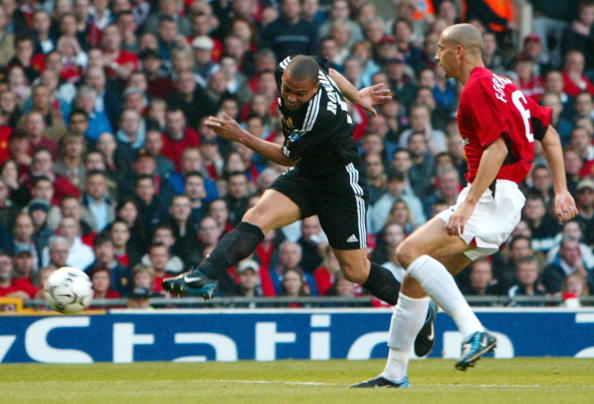 |
| 'The night belonged to Ronaldo, though the glittering array of talent around him (notably Zidane) made the most of United's imbalance and subsequent positional problems.' |
23rd April 2003 - the beginning of a tumultuous era at Old Trafford. What followed included a trophy drought, boardroom battles, in-fighting and, whisper it, a common acceptance that Sir Alex Ferguson should be replaced.
The game itself contained so many sub-plots. There was Beckham, then-England captain, inexplicably on the bench - rumours swirling of a summer move to the Bernabeu. Juan Sebastian Veron was selected to start after seven weeks out with injury - signed so extravagantly almost two years earlier, still stubbornly backed by a manager reluctant to admit an error of judgement. There was a fragility to the United squad, highlighted by the calibre of the opposition - Figo, Zidane and Ronaldo having won 6 FIFA World Player of the Year awards between them at that stage. The home bench featured 36-year old Laurent Blanc, the much-maligned Diego Forlan, two utility players in Phil Neville and Quinton Fortune plus the inexperienced Darren Fletcher. Finally, the selection of Steve McManaman in the Madrid midfield showed that their boss Vincente Del Bosque was (a) mischievous and (b) as adept at mind-games as his counterpart.
The night belonged to Ronaldo, though the glittering array of talent around him (notably Zidane) made the most of United's imbalance and subsequent positional problems. His first goal came from United gambling on a counter-attack and losing possession. The second saw one pass from Zidane take out three flat-footed United players. The third was simply an inspired strike.
For Fergie and United, the game was a water-shed. Despite claiming a 16th league title a few weeks later, Ferguson desperately had craved another European success - the signing of Veron was an attempt to add a calm, creative ball-player as a third central midfielder, having been so badly caught out tactically away to Anderlecht and PSV in 2000. Ruud Van Nistelrooy had been identified as a striker who could easily lead the line and excel with support from deep - a move away from the rigidness of attacking partnerships. But despite the brilliance of the Dutchman (with 10 goals in 11 tournament starts), United's defensive frailties cost them in the first leg of their semi-final with Bayer Leverkusen in 2002. Ferguson acted swiftly and broke the British record to sign Rio Ferdinand. But, with Wes Brown, Mikael Silvestre and John O'Shea playing in an assortment of defensive positions, United's defence never quite looked secure. Over two legs against Madrid, the deficiencies had come under the microscope. Now, it would be four years before the club would get as far in the Champions League again. The bulk of the squad would be moved on quickly. Barthez, Blanc, Veron, Beckham, Butt, Keane, Forlan, Phil Neville and Fortune all made their exits over the next three seasons. But most worryingly of all, Ferguson was about to enter his 'lost weekend' that lasted until 2006.
He had already made costly mistakes with his squad. The decision to replace Jaap Stam with Blanc had badly misfired. Bringing in Veron was well-intentioned but misguided - his role within the side never properly defined, his presence proving unsettling for others. The deterioration and eventual disintegration of his relationship with Beckham was alarming and unusual - Fergie seemingly allowing other factors motivate his decision to marginalise a player still doing it on the pitch. The heavy presence of model-pro Ole Gunnar Solskjaer as an antithesis to the Beckham 'celebrity circus' surely swayed his decision-making even further. The 1999 side had been ripped apart - Schmeichel, Irwin, Berg, Johnsen, Blomqvist, Cole, Yorke, Sheringham were all gone by the summer of 2002. Big money had been spent on a handful of players but the squad was still desperately short on numbers. The team needed a new goalkeeper, again. Ferguson, so impressed with the recent emergence of American shot-stoppers, signed Tim Howard from Major League Soccer. His first season would end with an FA Cup winner's medal but question marks remained. By the end of his second term, he'd lost his place to Roy Carroll, a back-up keeper signed from Wigan three years earlier. Only with the 2005 purchase of Edwin van der Sar did Ferguson finally land a consistent performer, a born winner, well able to deal with the inevitable, glaring spotlight.
Howard, infamously, had a part to play in United being dumped out of the Champions League by Porto in 2004 but so did Ferguson. With Keane suspended, Eric Djemba-Djemba was handed a start. With another makeshift back-four and Nicky Butt making what would be his final Champions League appearance, United were ill-prepared for the well-drilled, street-smart Portuguese outfit. Ferguson whinged about their antics, about an incorrect offside. Benni McCarthy, scorer of two goals in the first leg, said afterwards, 'United should try and respect their opponents a bit more'. Ouch.
The Champions League exit, the third-place league finish, the invincible Arsenal side under Wenger were all enough to give Ferguson plenty of restless nights. But what pushed him closest to the edge wasn't football-related at all. His biggest distraction were the legal proceedings he had begun in the Dublin High Court against John Magnier over ownership rights to the race-horse 'Rock Of Gibraltar'. At the time however, Magnier's company Cubic Expressions, owned over 25% of Manchester United. Magnier, a deeply private person, was secretly seething at Ferguson dragging their dealings into the public domain. In January 2004, Magnier and his business partner JP McManus sent letters to then-chairman Roy Gardner and CEO David Gill questioning Ferguson's transfer dealings and probing the amount of commission received by his then-agent son Jason from 13 different deals. Later that same year, a BBC3 documentary, 'Fergie And Son', delved deeper into the story (the same programme that resulted in Fergie Snr refusing to speak with the BBC until 2011). The letters also questioned why Ferdinand was still being paid his weekly wage of £70,000 despite serving an 8-month suspension for missing a drugs test. They questioned Ferguson's morals. They questioned his values. The most important question of all, perhaps most significantly, was left off the list. Though everyone with the ability to read between the lines knew what it was. Manchester United's biggest shareholders were questioning Sir Alex Ferguson's position as manager.
Ferguson was floored but was backed by hardcore supporters. Some formed United4Action and threatened to protest at that year's Gold Cup against what they viewed as Magnier and McManus's attempts to de-stabilise the club. A desperate Ferguson pleaded with fans not to go through with it. They honoured the request and a compromise was finally reached between Ferguson and Magnier later in the year.
But off-field battles were complemented by continued on-field troubles. The arrival of Mourinho at Stamford Bridge and the speed with which his newly-assembled side gelled stumped Ferguson. The unlimited cash, the brazenness, the brashness and most annoyingly of all, the results to back it all up. United offered little in response - the signing of Wayne Rooney offered plenty but injuries to Van Nistelrooy and Saha plus the relative ineffectiveness of Alan Smith saw him carry a heavy burden in his first campaign. Come March 2005, United were out of the title race again, out of Europe again (this time to AC Milan). They were flat-lining. The season petered out with a limp 3-1 home defeat to the title-winners Chelsea (which came complete with a humiliating guard of honour before kick-off) and an FA Cup final defeat to Arsenal. David Gill spoke of Ferguson, once the most untouchable man in European football, as 'sackable'. Blasphemy, surely? The man himself pondered if he had the energy to continue. The club's profits had more-than halved. Fergie was doing more bad than good.
In May 2005, John Magnier and JP McManus netted about an £80 million profit as they sold their share of the club to Malcolm Glazer. Shortly after, Glazer had full control. In July, the family pledged to stand by Ferguson and revealed there would be significant funds available to strengthen the squad. But the internal problems persisted. Keane was sacked by the club, his criticisms of younger players and of Ferguson's management seen as a bridge too far. Two and a half weeks later, United suffered the humiliation of being knocked out at the Champions League group stage. By the end of the campaign, Van Nistelrooy had gone too, sold to Madrid after Ferguson grew tired of what he perceived as a major drop in attitude, especially showcased in a 1-0 Cup defeat to Liverpool at Anfield. The season ended with another three goals shipped to Chelsea who eased to a second successive championship. In between, Ferguson incurred the wrath of the hardcore supporters when he described Glazer as being 'excellent for the club'. An editorial in the influential fanzine United We Stand said the comments smacked of "a struggling employee attempting to ingratiate himself with his new bosses. They are sickening, inflammatory but, above all, sad. Yes, Ferguson would be a fool to criticise the Glazers and hope to hang on to his increasingly tenuous position, but did he need to say anything?" Struggling, tenuous. The crown had slipped. The once loyal subjects were openly discussing anointing a new king.
But Fergie's lost weekend was over. He went back to basics but also borrowed from unusual sources. Nemanja Vidic was the powerful, commanding, physical centre-back not seen at Old Trafford since Stam. Patrice Evra was a converted attacker who could provide pace, skill and determination on the left-flank - in much the same way Ashley Cole did at both Arsenal and Chelsea. With Cristiano Ronaldo now less of a p ock-marked, flashy kid and more of an explosive, consistent revelation, Rooney also shone with extra responsibility. There was a solidity to the United side - in comparison to the softness witnessed so often in the years previous. The swagger was back, superbly demonstrated in the 7-1 demolition of Roma at Old Trafford in their Champions League quarter-final second leg. Though there was eventual defeat to a magnificent Milan in the semis, Ferguson knew a major foundation had been laid. Wrestling the league from Chelsea and seeing off a younger, aggressive, progressive rival manager proved many things - his critics were wrong to right him off. He never backed down from a challenge. He had the energy, will and desire to continue. He hadn't been faced with such relentless debate and argument about his credentials for a long time but he'd survived his toughest ever period at Old Trafford. He prepared himself for arguably his most successful.
Tuesday, February 19, 2013
Wenger Deserves To Leave Arsenal On His Terms Only
 |
| 'Where once Wenger's greatest foe and most vociferous opponent was Sir Alex Ferguson, now it's his once-loyal and once-passionate supporters.' |
Arsenal Fan 1: What about the last home game last season?
Arsenal Fan 2: What about it?
Arsenal Fan 1: They were rubbish. They were fucking rubbish.
Arsenal Fan 2: They weren't that bad.
Arsenal Fan 1: They were fucking rubbish last year. And they were fucking rubbish the year before. And I don't care if they are top of the League, they'll be fucking rubbish this year, too. And next year. And the year after that. I'm not joking.
Arsenal Fan 2: I don't know why you come, Frank. Honest I don't.
Arsenal Fan 1: Well, you live in hope, don't you?
Fever Pitch, 1997.
There will be a statue eventually. And when it's unveiled, people will talk only of the good times, out of respect. A bit like a funeral. In times of sombre reflection, no one wants to venture down the path of criticism, of finger-pointing, of asking those probing questions, of pointing out the faults. It feels bad. Disrespectful. Wrong. And it feels wrong chastising Arsene Wenger. It feels wrong discussing his demise. It feels wrong to call for his head. He's done too much for Arsenal and deserves better.
Or does he? The numbers are alarming, certainly. An eighth season without a trophy. But what would a trophy achieve? Would an FA Cup success this season have been applauded? Not really. The stat would simply be altered. 'Just one trophy in eight seasons', 'No league title in nine years', etc. The narrative never changes, only the details do. The Blackburn defeat was largely irrelevant. The Cup is not a priority for Arsenal or for any top Premier League team. It's a bonus. Will winning a Cup competition attract high-profile players? Will it lead to substantial financial reward? So, it should be treated like any other loss. It's disappointing, it's never nice to lose but let's move on. But it's been used to illustrate a fragility at Arsenal, a deep-rooted unhappiness and frustration. Recent history suggests tonight's clash at the Emirates will restore some faith, for the moment.
At this juncture last season, Arsenal had 46 points and were in joint-fourth place in the league, trailing Spurs by seven. They'd finish the campaign ahead of their local rivals, qualifying automatically for the Champions League group-stage. Right now they're on 44 points and in fifth, trailing Spurs by four. Premature to write them and Wenger off? Perhaps.
Much was made of how Arsenal would struggle without Robin van Persie. They have missed his ruthlessness, his ability to carve something from nothing, his leadership. But they haven't missed his goals. 53 scored by this stage last term, 50 right now. The Dutchman single-handedly won the club 27 points owing to goals he scored last season. This time, it's been a collective effort. Walcott, Giroud and Cazorla lead in terms of 'important goals' but Podolski, Arteta, and even Koscielny have contributed match-winning strikes. It's not as eye-catching, it's not as explosive but it's working.
The most important objective for Arsenal is to push themselves to the limit of their capabilities, be they financial or otherwise. From a football perspective, they haven't challenged for a title since 2008 and, on average, have finished 15 points behind the eventual winners in subsequent seasons. But if they can't compete for first and second, consistent Champions League qualification is the next best thing. And Wenger, a man so desperate to claim a European Cup, would not accept failure to do so. Yesterday, hearing him talk of his team's 'fantastic opportunity' to win this season's tournament, leads one to believe Wenger seriously fancies Arsenal to win a first ever Champions League before another championship. But gone are the days when a domestic also-ran claimed Europe's top trophy, last season aside.
Harsh, perhaps. But it's the biggest problem facing this Arsenal side - mediocrity becoming acceptable as the norm. Their start to last term a reminder of what can happen when a club rests on its laurels, Wenger forced into a humiliating emergency sweep of the transfer market to plug the gaps. But, the turnaround was superb, assisted by an unbeatable February and March in the league. He did turn it around. He did get there in the end. But, if there is a managerial change, expectations are lowered. The new man will need time. A delicate process. Suddenly, the traditional Champions League qualification isn't there anymore. The club is in transition. The club is in free-fall.
But, loyalty doesn't follow in the modern game. And where once Wenger's greatest foe and most vociferous opponent was Sir Alex Ferguson, now it's his once-loyal and once-passionate supporters. It's difficult to come back from that place - the constant struggle to prove yourself correct to those you've never had to. But Wenger deserves the right to back himself in situations like this. He deserves as much time as he needs. He deserves a statue.
Thursday, February 14, 2013
Solid Away Performance Gives United Steady Foundation
Real Madrid 1-1 Manchester United - Champions League Round of 16 - First Leg
Stereotypical in many ways. A terrific goalkeeping display, a little bit of good fortune and plenty of hard-work and energy. Manchester United got what they wanted from this away leg - a fixture they had been worried about. A difficult place to go. A Madrid team built on a glorious counter-attacking philosophy. Jose had Fergie's number. Madrid had United's. More nerves when Ferguson's starting XI was named. No Vidic, four attacking players selected, Phil Jones in central midfield. What happens if he gets it wrong? Was this side really capable of containing Cristiano Ronaldo?
There was plenty of trepidation in United's ranks, showcased by the early exchanges. United guilty of paying the Portuguese far too much respect. Everything became about him. Rafael the biggest culprit, diving recklessly into tackles, the rushes of blood to the head costing him position, balance and a booking. With so much energy (and personnel) sacrificed in trying to quell Ronaldo's influence, gaps emerged for other Madridistas to step through. Angel Di Maria was a constant threat throughout the first half, always looking to cut inside and either unleash a thundering shot or a deft pass while Mesut Oezil drifted superbly between the lines, going close a couple of times in the first half. It took United some time to take a breath and begin to properly understand the pattern and rhythm of the game. An attacking outlet came in the form of Madrid's occasional high line and Kagawa's movement off van Persie. The tactic saw the Japanese get in behind on four separate occasions, three of those attacks involving a through-ball or flick-on from the Dutchman and the last of which resulted in the corner that Welbeck scored from.
But it wasn't surprising that Madrid's equaliser came from the left side. Too often Rafael was isolated, with little back-up - Rooney having difficulties making up so much ground in transitions - the early chance for Fabio Coentrao perfectly illustrating United's huffing and puffing early on. But as the visitors improved their positioning, Madrid rotated their two wide-men, bringing Di Maria across to the near side and if United had succeeded in driving Ronaldo away from his natural habitat, they also succeeded in allowing a mercurial left-footer too much time to deliver a brilliant cross, albeit slightly too high. But Ronaldo applied a stunning finish, the leap so outrageous that his feet were in line with Patrice Evra's chest upon contact with the ball - the United full-back rooted to the spot as his former team-mate placed the header perfectly inside David De Gea's near post. An astonishing act of athleticism. Ronaldo suspended in the air for what seemed an eternity, seemingly defying science, certainly defying the constant critics.
As much as the game will be (and should be) remembered for the sublime beauty of Ronaldo's equaliser, there was another marvellous moment of agility in the second half. Kagawa, now swapped to the left side with Welbeck moved inside to keep tight to Alonso, suffered a defensive lapse, ball-watched and allowed Sami Khedira plenty of space to drill right across the six-yard area. Rooney reacted too slowly at the far post, allowing Coentrao to get in front of him, the full-back throwing himself at the ball, managing to drive it towards the near-post. De Gea, scampered across his line and, legs-first, diverted the ball to safety. Unconventional, unique and eye-catching. A metaphor for the Spaniard in one single save.
United's shape was much better in the second period. They did drop much deeper but as a result, more bodies were behind the ball, restricting Madrid's counter-attacking by being very disciplined and positionally astute - Phil Jones did this, almost to perfection, in the second half. The introduction of Ryan Giggs for Kagawa ensured more solidity on the back-foot though the ageless wonder did have a great chance to score with ten minutes to go - taking a needless touch in the area when a first-time strike was required.
By playing deeper and inviting the opposition to attack at every opportunity, United did endure some nervy moments late on. But, the quartet of Ferdinand, Evans, Carrick and Jones in particular were dogged and determined - winning challenges, getting vital touches and, essentially, doing the basics right.
In many ways, United's counter-attacking, when it happened (admittedly not very often), was very impressive in the second half. Welbeck, Giggs and Van Persie all had chances to score - the Dutchman will be haunted by his mis-hit, left-foot volley though Diego Lopez deserves credit for tipping his earlier effort onto the bar and, in injury-time, pushing away his low strike that arrowed toward the far corner.
Ultimately, a solid away performance featuring some rousing displays from younger players. Jones was immense while Welbeck went some way to answering those who constantly question his inclusion. The return game will be more of the same and pay little attention to the importance of the away goal - Madrid will score at Old Trafford - but do pay attention to the graft, energy and concentration. Three things that have been missing from United's European displays in recent years.
 |
| 'An astonishing act of athleticism. Ronaldo suspended in the air for what seemed an eternity, seemingly defying science, certainly defying the constant critics.' |
Stereotypical in many ways. A terrific goalkeeping display, a little bit of good fortune and plenty of hard-work and energy. Manchester United got what they wanted from this away leg - a fixture they had been worried about. A difficult place to go. A Madrid team built on a glorious counter-attacking philosophy. Jose had Fergie's number. Madrid had United's. More nerves when Ferguson's starting XI was named. No Vidic, four attacking players selected, Phil Jones in central midfield. What happens if he gets it wrong? Was this side really capable of containing Cristiano Ronaldo?
There was plenty of trepidation in United's ranks, showcased by the early exchanges. United guilty of paying the Portuguese far too much respect. Everything became about him. Rafael the biggest culprit, diving recklessly into tackles, the rushes of blood to the head costing him position, balance and a booking. With so much energy (and personnel) sacrificed in trying to quell Ronaldo's influence, gaps emerged for other Madridistas to step through. Angel Di Maria was a constant threat throughout the first half, always looking to cut inside and either unleash a thundering shot or a deft pass while Mesut Oezil drifted superbly between the lines, going close a couple of times in the first half. It took United some time to take a breath and begin to properly understand the pattern and rhythm of the game. An attacking outlet came in the form of Madrid's occasional high line and Kagawa's movement off van Persie. The tactic saw the Japanese get in behind on four separate occasions, three of those attacks involving a through-ball or flick-on from the Dutchman and the last of which resulted in the corner that Welbeck scored from.
But it wasn't surprising that Madrid's equaliser came from the left side. Too often Rafael was isolated, with little back-up - Rooney having difficulties making up so much ground in transitions - the early chance for Fabio Coentrao perfectly illustrating United's huffing and puffing early on. But as the visitors improved their positioning, Madrid rotated their two wide-men, bringing Di Maria across to the near side and if United had succeeded in driving Ronaldo away from his natural habitat, they also succeeded in allowing a mercurial left-footer too much time to deliver a brilliant cross, albeit slightly too high. But Ronaldo applied a stunning finish, the leap so outrageous that his feet were in line with Patrice Evra's chest upon contact with the ball - the United full-back rooted to the spot as his former team-mate placed the header perfectly inside David De Gea's near post. An astonishing act of athleticism. Ronaldo suspended in the air for what seemed an eternity, seemingly defying science, certainly defying the constant critics.
As much as the game will be (and should be) remembered for the sublime beauty of Ronaldo's equaliser, there was another marvellous moment of agility in the second half. Kagawa, now swapped to the left side with Welbeck moved inside to keep tight to Alonso, suffered a defensive lapse, ball-watched and allowed Sami Khedira plenty of space to drill right across the six-yard area. Rooney reacted too slowly at the far post, allowing Coentrao to get in front of him, the full-back throwing himself at the ball, managing to drive it towards the near-post. De Gea, scampered across his line and, legs-first, diverted the ball to safety. Unconventional, unique and eye-catching. A metaphor for the Spaniard in one single save.
United's shape was much better in the second period. They did drop much deeper but as a result, more bodies were behind the ball, restricting Madrid's counter-attacking by being very disciplined and positionally astute - Phil Jones did this, almost to perfection, in the second half. The introduction of Ryan Giggs for Kagawa ensured more solidity on the back-foot though the ageless wonder did have a great chance to score with ten minutes to go - taking a needless touch in the area when a first-time strike was required.
By playing deeper and inviting the opposition to attack at every opportunity, United did endure some nervy moments late on. But, the quartet of Ferdinand, Evans, Carrick and Jones in particular were dogged and determined - winning challenges, getting vital touches and, essentially, doing the basics right.
In many ways, United's counter-attacking, when it happened (admittedly not very often), was very impressive in the second half. Welbeck, Giggs and Van Persie all had chances to score - the Dutchman will be haunted by his mis-hit, left-foot volley though Diego Lopez deserves credit for tipping his earlier effort onto the bar and, in injury-time, pushing away his low strike that arrowed toward the far corner.
Ultimately, a solid away performance featuring some rousing displays from younger players. Jones was immense while Welbeck went some way to answering those who constantly question his inclusion. The return game will be more of the same and pay little attention to the importance of the away goal - Madrid will score at Old Trafford - but do pay attention to the graft, energy and concentration. Three things that have been missing from United's European displays in recent years.
Subscribe to:
Posts (Atom)